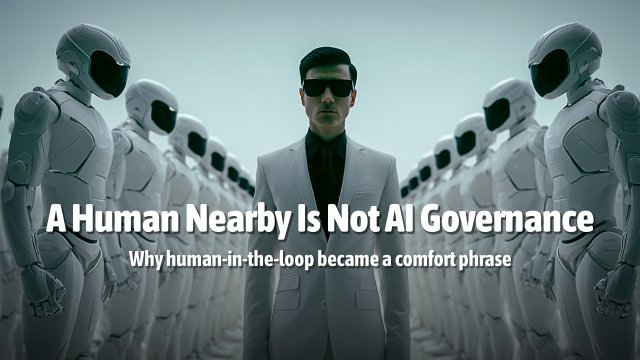

Why human-in-the-loop became a comfort phrase
“Human-in-the-loop” has become one of the most convenient phrases in AI adoption. It sounds responsible. It suggests judgment, restraint, and control. It gives executives, clients, regulators, employees, and audiences the feeling that automation has not been left to run on its own.
That is why the phrase is now everywhere. Companies use it in AI governance plans. Vendors use it in product descriptions. Agencies use it to explain AI-assisted content. Enterprise teams use it to reassure internal stakeholders that their workflows still contain human judgment.
The problem is that the phrase often carries more comfort than substance.
A human can be near an AI system without meaningfully controlling it. A human can be asked to review an output without having enough time, context, authority, training, or organizational support to challenge it. A human can be placed at the end of a workflow mainly to absorb accountability after the system has already shaped the result.
That is the uncomfortable side of human-in-the-loop. It can be a real control mechanism, but it can also become a polite label for weak oversight.
The issue is no longer whether organizations can say that humans are involved in AI workflows. Most can say that. The issue is whether the human role has been designed with enough authority to matter.
The strict version is about control
The strongest meaning of human-in-the-loop is straightforward. An AI system produces, recommends, classifies, drafts, flags, or decides something, but a human must review the output and make a judgment before it is used. In this version, the human is not simply participating. The human is a required control point. The workflow does not complete its relevant action until a person has approved, corrected, rejected, or escalated the output.
That is why the phrase belongs naturally in governance, compliance, financial decisioning, medical systems, legal workflows, hiring tools, content moderation, safety operations, and other areas where the consequences of an AI output can be material.
The term does not merely signal that a person looked at something. It signals that the person has a defined role in the operating architecture.
That difference is easy to lose in business language. A company may describe a process as human-in-the-loop because an employee sees the output before it moves forward. But seeing the output is not the same as controlling the outcome. If the employee has no practical ability to reject the AI recommendation, no standard against which to evaluate it, no escalation route, and no organizational permission to slow the workflow down, the control claim is weak.
The word “loop” should imply that the human is structurally inside the process. The system should be designed around the possibility that the human will disagree with the machine. If disagreement is not expected, supported, documented, and operationally possible, the loop is more decorative than functional.
Human-on-the-loop is a different model
A second version is often confused with the first. In some systems, the AI operates more independently while humans monitor its behavior and intervene when something appears wrong. That model is usually closer to human-on-the-loop.
This can be appropriate. Many AI-enabled systems operate at a volume, speed, or scale where every individual output cannot wait for human approval. A marketing team may supervise automated ad variations. A trust and safety team may monitor automated moderation. A customer support team may oversee chatbot patterns. A risk team may review exceptions instead of every low-risk decision.
The difference is that supervision is not the same as approval.
In a human-in-the-loop model, human judgment is part of the workflow before the relevant action takes effect. In a human-on-the-loop model, the system may already be operating while people supervise from the outside.
That does not make the model illegitimate. It makes it different.
Monitoring can be a strong control when the system is properly bounded, measurable, auditable, and interruptible. It becomes weak when the human supervisor is expected to catch problems after the system has already created them.
This distinction is becoming more important as AI moves from drafting tools into operating infrastructure. The more autonomous the workflow becomes, the easier it is for organizations to overstate the protection created by human supervision. A dashboard, an alert queue, or a review team may be useful, but none of those automatically proves that humans are meaningfully governing the system.
Human-in-command is the governance layer
The third concept is broader: human-in-command. This is not about reviewing every output. It is about who defines the purpose, limits, standards, deployment conditions, escalation rules, and accountability structure for the AI system.
Human-in-command thinking asks whether the organization has made deliberate choices before the workflow begins. It asks who decided that AI should be used for a task, which tools are approved, which data may enter the system, which outputs require review, which categories are off limits, and which risks are acceptable. It also asks who has the authority to pause, restrict, redesign, or shut down a system when its performance or consequences no longer fit the organization’s standards.
This is where many companies are still weak. They focus on adoption before operating design.
They buy tools, encourage experimentation, and then add a human review layer as a reassurance device. The result can look responsible from a distance while remaining fragile in practice.
Human-in-command is the part of AI governance that cannot be solved by asking employees to “check the output.”
It requires policy, workflow design, accountability, documentation, training, and management discipline. It also requires an honest recognition that the human role itself can fail. Humans can rubber-stamp machine outputs. They can defer to confident systems. They can miss errors when review volume is too high. They can become the formal accountability layer for decisions that were effectively shaped upstream by tools, templates, prompts, defaults, and organizational pressure.
That is why human oversight should not be treated as a person added to the process. It should be treated as a system designed around human authority.
Content creation exposes the confusion
Marketing and content creation make this problem especially visible. An agency may say that its content is not simply AI-generated, but human-orchestrated. That can be a useful phrase. It suggests that humans define the strategy, write the brief, shape the prompts, select the ideas, edit the language, align the work with the brand, and decide what gets published.
That is a legitimate creative-production claim. It is also broader than the classic governance meaning of human-in-the-loop.
Human-orchestrated content describes how the work is directed. Human-in-the-loop describes a control mechanism inside the workflow. The two can overlap, but they should not be treated as interchangeable.
A marketing team can be deeply involved in AI-assisted content production without having a serious governance model. People may guide the creative process, polish the copy, adapt the tone, and publish the final asset, while still lacking defined standards for factual claims, regulated industries, client approvals, disclosure, data use, copyright risk, brand safety, or escalation.
That does not make the content automatically bad. Many low-risk uses of AI in content production are practical and reasonable. But the language should be honest. “Human-orchestrated” may describe the creative process well. “Human-in-the-loop” is a stronger claim if it implies that the human role is not only creative, but also supervisory, accountable, and empowered.
The content field is now full of phrases designed to soften the reality of AI assistance. “AI-enhanced,” “Human-led,” “Human-guided,” “Human-orchestrated.”
Some of these are useful. Others are vague. The serious question is whether the phrase clarifies the workflow or merely makes the workflow sound safer.
The accountability trap
The sharper risk is not that humans will disappear from AI workflows. In many companies, humans will remain visibly present. They will approve, edit, monitor, sign off, and carry the final responsibility.
The risk is that they will carry that responsibility without real control.
That is the accountability trap. The organization gets the speed, scale, and cost advantage of automation while preserving a human signature at the end. If the output succeeds, the workflow looks efficient. If the output fails, the human reviewer becomes the point of accountability.
This is not only a compliance problem. It is an operating problem.
A human reviewer who is expected to check too much, too quickly, with too little context is not a meaningful control. A manager who approves AI-generated materials without understanding the model, the prompt chain, the source material, or the risk category is not providing serious oversight. A team member who cannot reject the system’s output without creating delay, conflict, or performance pressure is not truly empowered.
In that environment, human-in-the-loop can become governance theater. The company can say that people remain involved, while the structure of the workflow quietly reduces their ability to exercise judgment.
This is especially dangerous in enterprise environments because weak oversight often looks reasonable at first. There is a policy. There is a reviewer. There is a final approval step. There may even be a checklist. But if the reviewer does not have authority, standards, time, and escalation power, the structure may create more liability than protection.
The real test is authority
The better way to evaluate human oversight is to focus on authority. A meaningful human role requires more than presence. The person needs enough information to understand what the AI system has produced and why it may be risky. The person needs a standard against which to evaluate the output. The person needs enough time to review the work properly. The person needs permission to disagree with the system. The person needs a clear escalation route when the output creates uncertainty. The person also needs protection from being turned into the convenient owner of a decision that the organization has effectively automated.
This is where many AI adoption programs need to become more mature. Governance is not created by placing a human somewhere in the workflow and declaring the problem solved.
Governance is created when the human role is specific, empowered, documented, and connected to the organization’s risk model.
For executives, this has practical consequences. When a vendor promises human-in-the-loop safeguards, the question should be what the human can actually do. When an internal team says AI-generated output is reviewed by people, the question should be how the review works. When an agency describes content as human-orchestrated, the question should be whether that phrase describes creative direction or actual oversight.
These are not semantic details. They determine whether the organization has a defensible workflow or only reassuring language.
The next phase of AI adoption needs better language
AI is moving from experimentation into normal business infrastructure. That shift changes the standard for oversight. During experimentation, vague language may be tolerated because the stakes appear limited. Once AI becomes part of client work, legal review, HR processes, customer communication, marketing operations, research workflows, or decision support, vague language becomes a weakness.
The next phase will require companies to describe their AI workflows with more precision. They will need to know when humans approve outputs, when they monitor systems, and when they govern the overall use case. They will need to distinguish between creative orchestration and control. They will need to identify where the human has real power and where the system is only being watched.
Human-in-the-loop can still be a useful phrase. It should not be abandoned. But it should be used carefully.
A human nearby is not AI governance. A human reviewer is not automatically a control. A human signature at the end of an automated workflow is not proof of judgment. The loop only matters when the human has authority inside it.
Otherwise, the human is not oversight. The human is cover.