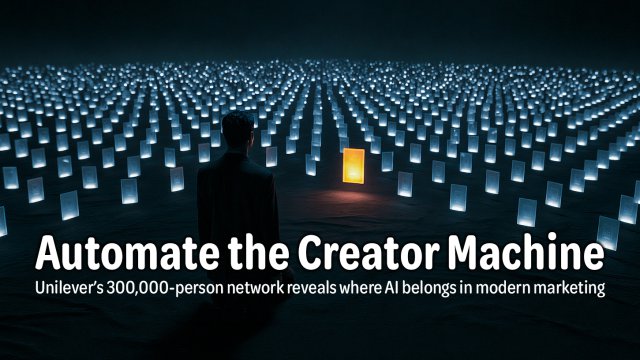

Unilever’s 300,000-person network reveals where AI belongs in modern marketing
The most instructive development in AI marketing may not be an artificial campaign, a synthetic spokesperson, or a machine-generated commercial. It may be a consumer-goods company using AI to manage the administrative burden surrounding approximately 300,000 human creators.
Unilever has expanded its creator program from roughly 10,000 participants to 300,000. At that scale, influencer marketing stops resembling a collection of individual partnerships and starts functioning like an operating system. Creators must be discovered, screened, matched with brands, briefed, approved, monitored, measured, paid, and managed across markets with different languages, laws, customs, platform cultures, and reputational risks.
That workload cannot be handled by adding more spreadsheets and coordinators. Unilever is therefore automating much of the machinery around the creator relationship while reserving the relationship itself, along with consequential creative decisions, for people.
The approach offers a more credible model for AI adoption in marketing than the familiar promise that technology will replace large portions of the creative workforce. Unilever is applying automation where scale has made manual administration impractical. It is being more cautious where cultural judgment, mutual trust, creative originality, and brand responsibility remain difficult to reduce to a repeatable system.
The dividing line will not always remain where it is today. Still, the current model clarifies a question that many marketing organizations have avoided: which decisions should AI make, which should it support, and which should remain recognizably human?
A Network This Large Is No Longer a Campaign
Influencer marketing developed around relatively small groups of recognizable creators. A brand might work with five, ten, or twenty-five people on a campaign, often through an agency that handles contracts, briefs, approvals, and reporting.
A network of 300,000 creators is a different proposition. Unilever sells products in more than 190 countries, and its creator strategy spans global brands, local communities, emerging cultural moments, paid partnerships, unsolicited product advocacy, and user-generated content.
No marketing department can manually search the social web for every relevant person discussing Dove, Vaseline, Hellmann’s, Knorr, or another Unilever brand. Even if it could, finding candidates would be only the beginning.
Each prospective creator brings a history of posts, commercial relationships, audience characteristics, public controversies, stylistic preferences, and local cultural context.
The operational burden rises faster than the creator count. A larger network produces more content, contracts, permissions, deadlines, approvals, payments, performance data, and potential exceptions. The value of scale can disappear beneath the cost of coordinating it.
AI enters here as organizational infrastructure. It can scan large volumes of content, identify people already speaking favorably about a product, compare creators with campaign requirements, assemble preliminary shortlists, standardize documentation, and collect information that would otherwise be distributed across platforms and teams.
Those activities do not produce the relationship or the creative idea. They make both manageable at a scale that would otherwise defeat the organization.
What Unilever Is Handing to the System
According to Digiday, Unilever uses technology to identify creators who are already sharing positive experiences with its products. Automated systems can search social video at a volume and speed that manual research cannot approach.
The company is also using AI in creator vetting and brand-safety work. A system can examine a creator’s publishing history, flag past controversies, and determine whether the person appears compatible with a specific brand. Other tasks suitable for automation include collecting campaign data, preparing briefings, standardizing documents, and organizing the information needed for approvals.
These functions are sometimes dismissed as grunt work, but they contain meaningful judgment. A list of recommended creators can shape who receives commercial access, whose voice becomes associated with a brand, and which communities receive marketing investment. A brand-safety flag can exclude someone from an opportunity or trigger closer human review. A standardized brief can improve coordination, but it can also constrain the range of acceptable creative interpretations.
The system is not merely filing paperwork. It is influencing the conditions under which creative and commercial decisions are made.
That makes the design of the workflow as consequential as the model's capability. Companies need to know which signals are used to identify creators, how reputational concerns are classified, whether historical context is preserved, how disputed flags are reviewed, and who can override the recommendation.
At 300,000 creators, small defects in selection logic become structural. A system that repeatedly favors established formats, familiar demographics, easily measured audiences, or unusually compliant creators may produce an orderly network that gradually loses cultural range.
Efficiency can narrow the field without anyone explicitly deciding to narrow it.
Creator Selection Has Become a Governance Function
Influencer selection is often treated as a media-planning exercise. The brand identifies an audience, searches for creators with access to that audience, compares engagement and cost, and chooses the strongest candidates. That description understates the responsibility involved.
Creators speak in their own voices while carrying a brand into communities where conventional advertising may have limited credibility. Their conduct can expose the company to reputational harm, disclosure violations, misleading claims, copyright disputes, cultural backlash, or conflicts with other commercial relationships.
The brand may not write every word, but it remains connected to what is published on its behalf. Automating discovery and screening, therefore, moves AI into an area where marketing execution, risk management, and governance overlap.
The relevant controls cannot consist solely of an approved-tools list or a general statement that a human remains involved. A useful governance model must establish what the system is allowed to recommend, what information it may use, which decisions require review, how adverse findings are handled, and whether creators can correct inaccurate data.
A creator who is rejected because an automated system misreads satire, confuses identities, fails to understand a local controversy, or treats an old allegation as a settled fact may never know why the opportunity disappeared. A marketer presented with a polished shortlist may never see the qualified candidates the system omitted.
Human approval at the end of a process offers limited protection when earlier automated stages determine which options reach the human at all.
The central control point is therefore not only the final decision. It is the construction of the decision environment.
The Relationship Is Where the Value Lives
Unilever’s current boundary is revealing. The company appears willing to automate the work surrounding the relationship but not the relationship itself.
That is commercially rational. Creator marketing depends on access to a form of credibility that brands cannot manufacture directly. Creators understand the tone, expectations, humor, sensitivities, and changing interests of their communities. Their value does not come solely from distribution. It comes from the trust and cultural fluency attached to their presence.
A relationship managed entirely through automated instructions, performance scores, and approval gates can weaken those qualities. Creators may learn that strict compliance leads to faster approvals, while experimentation leads to flags, revisions, or reshoots. Over time, they begin optimizing for the system rather than for their audience.
The result may be safe, measurable, and forgettable content.
Digiday’s reporting captures that concern. Greater automation can encourage creators to adhere to rigid briefs, as deviation increases the risk of delayed approval. The process may discourage precisely the originality that made the creator attractive in the first place.
A brand can easily mistake controlled production for effective creator marketing. The content arrives on time, the required language is included, prohibited claims are absent, and every asset fits the specification. Yet the audience recognizes that the creator is performing a corporate instruction rather than expressing a credible point of view.
The operational system has succeeded while the marketing has failed.
Human relationship management provides room for negotiation, explanation, trust, and informed deviation. It allows a brand to understand why a creator wants to change the brief and lets the creator understand which constraints are legally or strategically nonnegotiable. That exchange cannot always be captured in a dashboard.
Agencies Face a Different Kind of Disintermediation
The implications for agencies extend beyond the question of whether AI reduces headcount. A brand capable of discovering, vetting, coordinating, and measuring hundreds of thousands of creators through its own infrastructure may no longer need an intermediary to perform the same work in the same way.
Many influencer agencies built their value around access to creator rosters, campaign coordination, contracting, approvals, and reporting. Those services remain useful, but parts of the model become vulnerable when technology lowers the cost of identification and administration.
The threat is greatest for agencies whose main contribution is logistical throughput. If a client’s system can generate qualified shortlists, conduct initial screening, issue standardized materials, track submissions, and consolidate performance data, charging for manual coordination becomes harder to defend.
The opportunity lies higher in the value chain. Agencies can help brands design creator portfolios, interpret cultural shifts, negotiate complex collaborations, develop concepts that give creators room to contribute, resolve conflicts, navigate local regulations, and audit the systems used to select and evaluate participants.
They can also provide an external challenge to the brand’s internal machinery. A company operating its own creator platform may become overly confident in the neutrality of its data or the completeness of its measurement. Agencies with independent expertise can identify blind spots, test assumptions, and reveal when operational efficiency is eroding creative effectiveness.
Influencer agencies will not disappear simply because Unilever has automated parts of the workflow. They will, however, face pressure to explain what remains valuable once access, administration, and basic matching become software functions.
The agency of the future may manage fewer spreadsheets and more exceptions. It may spend less time assembling lists and more time questioning why the system assembled the list it did.
Holdcos Cannot Sell Automation Alone
Agency holding companies have spent years developing proprietary platforms that promise integrated data, automated planning, rapid content production, audience intelligence, and measurable execution. Unilever’s approach gives clients a practical standard against which those claims can be judged.
The relevant question is no longer whether an agency uses AI. Every major group can answer yes. Advertisers need to know which parts of the operating model have improved, what the technology contributes independently, where human judgment remains decisive, and who owns the resulting data and relationships.
Creator management makes these questions unusually concrete.
Does the platform identify candidates from the open social web or only from a proprietary roster? Can the advertiser retain creator profiles, campaign histories, and performance information after changing agencies? Does the system explain why a creator was recommended or rejected? Can local teams challenge a global brand-safety classification? Are creators developing a relationship with the brand, the agency, or the platform?
These are not technical details buried beneath the marketing service. They determine whether the client is building an enduring capability or renting access to someone else’s infrastructure.
Holdcos may respond by positioning themselves as operators of complex creator ecosystems rather than brokers of influencer campaigns. That requires genuine interoperability, transparent governance, portable data, and strong human expertise across markets. A closed platform supported by generic claims about AI will be less persuasive as major advertisers build their own systems and demand evidence of incremental value.
Scale Changes What Marketing Management Means
Unilever’s network also challenges the conventional boundary between media, creative production, customer advocacy, community management, and commerce.
A creator may begin as a consumer who posts an unsolicited product recommendation. The brand discovers the content, evaluates the person, initiates a relationship, commissions further work, measures resulting searches or sales, and eventually involves the creator in product development or revenue sharing.
Unilever’s Vaseline Originals initiative illustrates how far such relationships can develop. The company returned to creators associated with product-use ideas, collaborated with them on products, and established a share of sales for participating creators.
At that point, the creator is no longer simply an advertising placement. The person contributes intellectual and cultural value to product development, distribution, and demand generation.
Operating this model requires systems that preserve history across interactions. A brand must know how the creator was discovered, what the person contributed, which rights were granted, how compensation was determined, and whether later commercial use remains within the original agreement.
AI can help connect that information and make it usable. It can also blur accountability if separate automated tools handle discovery, risk scoring, contracting, content review, and measurement without a coherent record of how decisions traveled through the system.
The larger the network, the less acceptable fragmented governance becomes. A company cannot meaningfully claim human control if no individual or team can reconstruct how an important creator decision was reached.
The Best Automation Leaves Room for Surprise
The commercial promise of AI in creator marketing is easy to understand. Brands can find more relevant voices, operate in more markets, respond faster to cultural moments, and reduce the administrative costs associated with each relationship.
The strategic danger is equally clear. Systems are good at identifying patterns that resemble what has worked before. Creator marketing often becomes valuable when someone sees the product, audience, or cultural moment differently from everyone else.
A selection model trained on past campaign performance may favor creators whose work fits established expectations. A brand-safety system may penalize provocative voices even when they are culturally influential and appropriate for a particular campaign. An approval system may reward familiar execution because it is easier to classify.
This produces a tension that cannot be solved by choosing either complete automation or complete manual control. Brands need enough automation to make scale possible and enough human discretion to prevent scale from becoming sameness.
The strongest systems will not simply process the largest number of creators. They will preserve the ability to recognize an unusual fit, understand a local exception, revisit a questionable flag, and approve an idea that does not resemble the database of previous successes.
That requires technical capabilities, but it also requires organizational permission. Employees must be able to challenge the system without being treated as inefficient. Creators must have channels through which context can be added. Decision-makers must accept that some of the most valuable collaborations will not be the easiest ones to score.
A More Credible Model for AI in Marketing
The significance of Unilever’s approach lies in how it allocates work. The company is not presenting AI as a substitute for the people whose voices make creator marketing credible. It uses technology to manage the volume of discovery, screening, coordination, and information processing that people cannot reasonably perform by hand.
That allocation will continue to evolve. AI may take on more briefing, negotiation support, content review, performance forecasting, and campaign optimization. Human teams may grow more comfortable delegating decisions as the systems improve and evidence accumulates.
Every expansion of authority should be evaluated according to the consequence of error, the availability of meaningful review, and the effect on the relationship being managed.
Automating a document format is not equivalent to automating a reputational judgment. Ranking potential creators is not the same as deciding whether a controversial person deserves exclusion. Generating a brief is not equivalent to understanding how a creator’s audience will respond to it.
Unilever’s 300,000-creator network shows that AI can change marketing’s operating model without removing the human center of the work. It can make a vast relationship network administratively possible while leaving trust, originality, cultural interpretation, and responsibility where they still belong.
The challenge is to prevent the machine built to support those relationships from quietly redefining them.