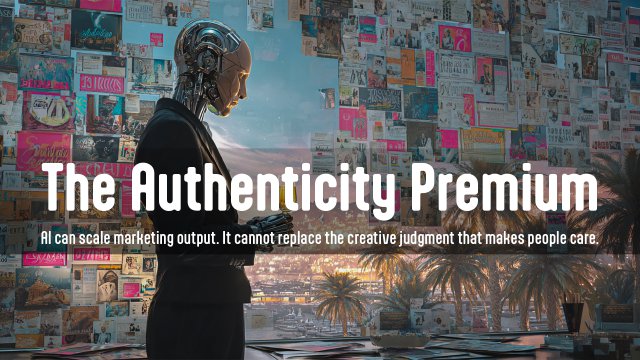

AI can scale marketing output. It cannot replace the creative judgment that makes people care.
Cannes Lions Is Moving Past the Easy AI Conversation
The marketing industry has spent the past two years talking about what AI can make. At Cannes, the more useful conversation is starting to move toward what AI cannot make.
That shift is more important than another round of platform announcements, agency tools, and productivity claims. The industry already understands that AI can create more assets, more variations, more translations, more campaign drafts, and more content for more channels. The operational case is no longer difficult to explain. AI can lower production friction and expand the range of what teams can test, adapt, and distribute.
The harder question is what happens after that capability becomes normal.
Two Axios reports from Cannes point to the same answer from different directions. One captured media and brand leaders arguing that AI can flood the market with generated content, while real reporting, real outcomes, real personalities, and real human presence become more valuable. The other covered marketing leaders who argued that AI should amplify creativity, not replace the judgment and taste that make creative work worth paying attention to.
Together, the two stories describe a more mature phase of AI in marketing. The early conversation was about generation. The next one is about authenticity.
That does not make the argument anti-AI. It makes it more commercially serious. AI can be useful, powerful, and increasingly embedded in marketing operations. It can also expose how much of the industry has confused production volume with creative value.
Production Is Not Presence
AI is excellent at producing artifacts. It can draft copy, generate images, summarize research, translate video, adapt campaigns across markets, and create endless variations from a single creative direction. For large brands and agencies, that has immediate value. There is real money trapped in manual processes that are slow, repetitive, and expensive.
The Axios roundtable on creativity captured that operational reality. Hilton’s global marketing executive Dan Reynolds pointed to photography, video translations, copy, and pricing as processes that consume money and time that could otherwise support stronger brand storytelling. That is a practical use case, not a fantasy. AI can remove drag from marketing systems that were never designed for the volume and speed now required.
But production is not presence.
A generated image can look polished without feeling earned. A campaign line can be fluent without carrying conviction. A synthetic brand story can follow the right emotional pattern and still feel empty. A machine can produce an asset that resembles communication, but it cannot create the underlying reality that gives communication its force.
Leaders at Axios House discussed the one thing AI cannot manufacture: something real.
In media, that includes reporting, original work, live events, personalities with actual histories, and shared moments that audiences recognize as unscripted or earned. In brand building, it includes consistency, lived credibility, and a relationship with an audience that has been built over time.
AI can imitate the surface of many of these things. It cannot create the event, the risk, the history, the accountability, or the human continuity behind them.
Marketing leaders should take that distinction seriously. The market will not reward content simply because it exists in greater volume. As synthetic content becomes ordinary, audiences will become more sensitive to whether a message feels grounded in anything real.
The Authenticity Premium
Authenticity is often treated as a soft marketing word. It can sound like a mood board value or a post-rationalized campaign attribute. AI is turning it into something more concrete.
In an AI-saturated environment, authenticity becomes a premium attached to work that carries recognizable judgment, human context, and a credible relationship to the brand’s actual behavior. It is the value of work that feels less like a generated artifact and more like a decision made by people who understand what they are saying, why they are saying it, and what it costs to say it publicly.
That premium exists because AI increases supply faster than it increases attention.
When every brand can generate more, more generation stops being impressive. When every agency can produce more variations, variation becomes a commodity. When every company can localize, personalize, and adapt content more quickly, speed becomes an expected operating capability rather than a strategic advantage.
The scarce layer becomes judgment.
Audiences may not always know which tools were used in the production process, but they often recognize when the work has no weight behind it. The problem is not only whether something is AI-generated. The deeper problem is whether it feels generic, opportunistic, emotionally false, or disconnected from what the brand has actually earned permission to say.
That is the authenticity premium. It belongs to brands and agencies that use AI without letting AI flatten the brand. It rewards the teams that can produce faster without sounding interchangeable. It rewards the organizations that can automate more of the mechanical work while protecting the human signals that make the work believable.
The premium will not be created by disclosure labels alone. Disclosure can be appropriate, especially when synthetic people, voices, images, or events are involved. But a disclosed synthetic campaign can still feel hollow, while an AI-assisted campaign can still feel credible if the idea, judgment, and brand truth are strong.
The real issue is not whether AI touches the work. The real issue is whether the work remains connected to a human decision that an audience can respect.
AI Still Needs Creativity
The weakest version of the AI marketing debate asks whether AI will replace creative people. That framing is too crude for the reality now emerging inside agencies and brand organizations.
AI will replace some tasks. It will compress some timelines. It will reduce the value of certain forms of executional labor. It will change how assets are made, tested, adapted, and delivered. None of that should be dismissed.
But AI will not become valuable in marketing without creativity.
The areas where creativity is needed will move. They may sit less in the manual creation of every asset and more in the definition of the problem, the quality of the brief, the selection of the right direction, the rejection of plausible but weak options, and the final judgment about what a brand should put into the world.
That is still creative work. In many cases, it is the most valuable creative work.
Creativity is not only the act of writing a line, designing a layout, editing a film, or producing a campaign route. Creativity is also the ability to understand tension, read culture, protect a brand’s voice, identify what an audience will reject, and sense when a technically good idea is strategically wrong.
AI can generate options. It cannot independently know which option deserves to exist.
That is not a sentimental defense of human creativity. It is a commercial one. Marketing is filled with decisions that cannot be solved by fluency. A campaign can be well written and still damage trust. An image can be visually strong and still feel false for the brand. A message can be efficient and still strip away the emotional reason people cared in the first place.
For creative people inside the major holdcos, this is the more useful way to understand the shift. The value of creativity is not disappearing. The industry is being forced to separate creativity from production habit.
If creativity is treated only as manual output, AI will absorb more of it. If creativity is understood as judgment under uncertainty, it becomes the layer that governs the system.
The more AI can produce, the more valuable it becomes to know what should never be produced.
The Agency Role Gets Harder
This creates a direct challenge for agencies. If every agency can offer AI-enabled production, production scale will not remain a meaningful differentiator for long. Clients will expect faster adaptation, more variations, lower friction, and lower cost. The technology will raise the baseline.
The agency's role then moves toward the architecture around the work. That architecture includes creative standards, brand governance, review processes, provenance rules, synthetic media policies, risk controls, and the ability to preserve judgment inside a system built for speed.
This is a harder role than producing more content. It requires agencies to help clients decide where AI should accelerate the workflow and where the human layer must remain visible, accountable, and strong. It also requires agencies to resist the temptation to present volume as transformation.
Volume without judgment is not transformation. It is industrialized sameness.
The major holdcos understand the pressure. Their AI platforms are being positioned as operating systems for modern marketing. That may be necessary. But the strategic value of those systems will not come only from how much they can generate. It will come from whether they can help clients protect distinctiveness, trust, and brand meaning while operating at AI speed.
That is where creative people still matter. It is also where governance-minded executives should pay attention. The same systems that help a brand move faster can also make the brand more generic, more synthetic, and more vulnerable to reputational mistakes if they are deployed without strong creative control.
The New Marketing Question
Marketing teams have long asked whether work is on brand, on time, on budget, legally approved, and performance-ready. Those questions still matter.
AI adds a sharper question. Is the work still connected to something real?
That question applies to campaigns, images, voices, influencer programs, brand claims, customer stories, thought leadership, and personalized content. It applies when AI is visible and when it sits quietly inside the workflow. It applies to the creative department, the legal team, the agency partner, the media buyer, and the executive who approves the final work.
The brands that handle this well will not be the ones that avoid AI. They will be the ones that understand where AI belongs and where it becomes dangerous to let the machine define the emotional center of the work.
AI can make marketing faster. It can make production cheaper. It can make adaptation easier. It can help teams explore more territory before committing to a direction.
It cannot make people care on its own.
The authenticity premium is the market’s response to AI abundance. When everyone can generate, the advantage moves to the brands and agencies that still know how to mean something.