
Cannes Lions showed that AI in marketing is moving from content production to workflow control
The Agency Operating System
For a while, AI in marketing was treated as a production story. It wrote copy, generated images, built variations, shortened timelines, and helped teams produce more content with fewer delays. That phase is not over, but it is no longer the most interesting part of the market.
The more important shift is now happening behind the campaign. Cannes Lions made that visible. The industry is no longer talking only about AI as a creative assistant. It is talking about AI as an operating layer for media buying, streaming advertising, creator inventory, performance optimization, and marketing workflow.
That changes the competitive question for agencies, holding companies, platforms, and clients. The question is no longer who can generate the most assets. The question is who controls the system in which marketing decisions are made, executed, measured, and revised. That is a much larger fight.
From Creative Output to Marketing Orchestration
The first public wave of marketing AI was easy to understand because it appeared on the surface. A brand could produce more headlines, more social posts, more images, more video variations, and more campaign concepts. The benefits were visible. The limits were visible as well.
More content does not automatically create better marketing.
In many organizations, it creates more approvals, more brand-risk reviews, more asset management problems, and more uncertainty about what actually worked. The old workflow remains intact, but it is now asked to process a higher volume of material.
The Cannes announcements point to a different direction. Agentic AI is being positioned as a way to coordinate decisions across the marketing supply chain. The system does not merely make an ad. It helps decide which audience should receive it, where it should run, how it should be adapted, how inventory should be evaluated, how performance should be measured, and how the next decision should be made.
That is not creative automation in the narrow sense. It is operational automation across the marketing function.
The announcements around buyer agents, seller agents, orchestration layers, AI memory systems, and programmatic creator marketplaces are more important than another demo of AI-generated copy. The strategic center of gravity is moving from production to coordination.
Why Interoperability Became the Real Problem
Marketing technology has never lacked tools. It has lacked clean coordination between them. Brands have lived with fragmented platforms, disconnected reporting, incompatible data structures, inconsistent taxonomy, and a permanent argument about which system should be treated as the source of truth.
Agentic AI makes that old problem more urgent. If software agents are supposed to interact with other software agents, then the industry needs more than impressive models. It needs technical protocols, permission structures, audit trails, approval thresholds, and shared rules for how decisions move between systems.
Without interoperability, agentic marketing becomes another layer of fragmentation.
Each vendor builds its own agent. Each platform builds its own logic. Each media owner protects its own environment. Each agency promises a smoother workflow, but the client still has to reconcile the outputs afterward.
That is why the WPP Media buyer-agent announcement is worth watching. The interesting part is not merely that WPP is testing a video-buying agent. The more consequential part is the standards and governance effort around how buyer agents and seller agents communicate in premium video environments. Once agents begin negotiating, recommending, and executing across media supply chains, the rules of interaction become part of the product.
Agencies understand this. Platforms understand this. Clients should understand it as well. The party that defines interoperability can influence how the market operates.
Why Clients Want Control
Clients have spent years asking for transparency in media. They wanted to know where money went, how fees were structured, how inventory was selected, which data was used, and whether agency incentives were aligned with client outcomes. Agentic AI does not eliminate those concerns. It can intensify them.
When a human planner recommends a media decision, a client can ask for the rationale. When an automated system recommends, revises, and potentially executes decisions across several platforms, the client needs a different kind of evidence. It needs to know which data informed the system, which constraints were applied, which choices were rejected, when human approval was required, and whether the recommendation served the client or the intermediary.
This is where the control question becomes commercial. Agencies will argue that their agentic systems create better decisions because they combine data, media relationships, workflow knowledge, and operational scale. Clients will ask whether those systems make the agency more valuable or more difficult to audit.
Both positions can be true at the same time. A strong operating architecture can create real advantage. It can also create dependency.
That is why in-housing pressure will not disappear. If agentic systems reduce the complexity of media planning and buying, some brands will ask whether they still need the same agency structure. The Digiday coverage of agencies and in-housing pressure shows that this concern is already present. Agencies are not only competing with one another. They are competing with the possibility that clients use similar tools to bring more of the work inside.
The new agency defense will not be access to AI alone. Clients can buy tools. The defense will be architecture, governance, integration discipline, and proof that the agency can produce better outcomes than a client can produce with the same underlying technology.
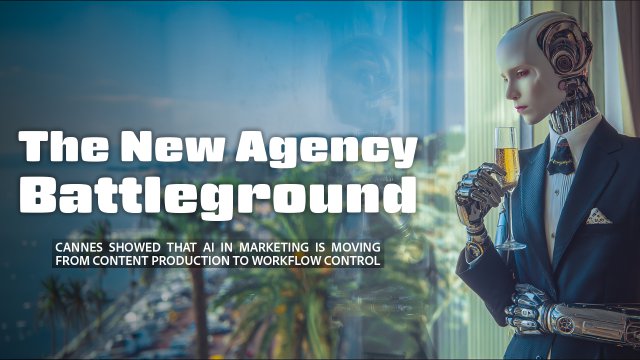
The New Agency Battleground
The next agency battleground is not simply creative quality. It is operating architecture. That phrase may sound less glamorous than creativity, but it is where the money and power are moving. An operating architecture determines how data enters the system, how decisions are made, how media is bought, how creative variants are deployed, how feedback loops work, and how accountability is documented.
This is why holding companies are investing so heavily in platforms, data assets, workflow systems, and proprietary AI layers. They are trying to become more than service providers. They want to become the environment in which marketing work happens.
Omnicom’s Cannes partnership with Netflix shows how this may look in practice. Audience data, streaming inventory, AI-supported creative customization, measurement, and media activation are being tied together into a more integrated advertising process. That is not just an ad placement story. It is a systems story. The agency network wants to connect data, creative, media, and measurement in ways that make its operating platform harder to replace.
WPP’s buyer-agent work points in a related direction from another angle. It is not only selling automation. It is trying to shape how agentic media buying works across premium video environments. If that effort succeeds, the agency is not merely using the system. It is helping define the system.
That is the strategic move. The most valuable agency may not be the one with the most AI tools. It may be the one whose architecture becomes the client’s default way of operating.
The Governance Layer Becomes Commercial
Governance is often treated as a constraint on innovation. In agentic marketing, governance may become part of the commercial offer.
A client that allows AI systems to influence media buying, creative adaptation, campaign setup, and performance optimization needs more than speed. It needs documented control. It needs clear escalation paths. It needs approval rules. It needs visibility into how recommendations are formed. It needs a way to determine whether the system is optimizing toward the right business objective.
That is not a legal afterthought. It is a buying criterion.
The more autonomous the marketing workflow becomes, the more valuable governance becomes. A client will not judge an agency platform only by how much work it automates. It will judge whether the system can be trusted with budget, brand, data, and decision rights.
This may create a new form of agency differentiation. The winning pitch will not be that AI can move faster. Everyone will say that. The stronger pitch will be that the agency can move faster while preserving control, accountability, interoperability, and client-specific judgment.
That is a harder promise to make. It is also the promise that serious clients will care about.
What Cannes Really Signaled
Cannes Lions is still a festival of creativity, reputation, relationships, and performance theater. But the ad-tech announcements around agentic AI suggest something more structural than the usual trade-show noise.
Marketing is becoming more automated, but the deeper shift is that marketing is becoming more systematized. Decisions that once moved through meetings, spreadsheets, platform dashboards, and agency handoffs are being pulled into software architectures that can remember context, coordinate workflows, and act across environments.
That will change what agencies sell. It will change what clients buy. It will change where control sits.
The agency of the near future may still be judged by the quality of its ideas. It will also be judged by the quality of its operating system.