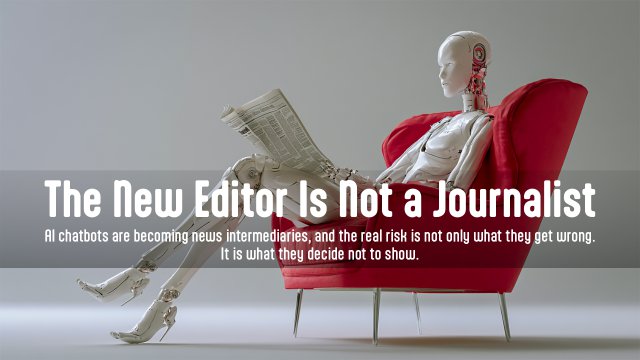

AI chatbots are becoming news intermediaries, and the real risk is not only what they get wrong. It is what they decide not to show.
The Quiet Shift in News Consumption
The Reuters Institute’s 2026 Digital News Report contains a finding that deserves far more attention than it is getting. Weekly use of AI chatbots for news has risen from 7% to 10% globally. Among younger users, the number is higher. The report describes the growth as fast rather than explosive, which is true in a statistical sense. In a structural sense, however, the shift is already significant.
A chatbot does not behave like a newspaper, a search engine, a television channel, or a social feed. It does not simply present a list of stories and leave the user to choose. It produces an answer. That answer may include fragments of reporting, background context, competing claims, rewritten explanations, and a confidence tone that makes the whole package feel coherent.
That is a very different news experience. The user no longer moves through headlines, sources, bylines, links, editions, and editorial judgment in a visible sequence. The user asks a question and receives a synthesized response.
The traditional news industry has spent years trying to adapt to social distribution. It learned to deal with feeds, platform ranking, search visibility, newsletter retention, mobile formats, push notifications, and creator competition. Chatbots introduce a deeper problem. They do not merely sit between publishers and audiences. They can absorb the function of explanation itself.
The New Gatekeeper Does Not Look Like One
The most important change is mediation. A chatbot becomes a gatekeeper precisely because it does not look like a gatekeeper. It looks like a helpful interface.
When users ask what happened in Ukraine, whether a court ruling matters, why a company’s stock moved, or what the latest policy proposal means, the chatbot has to make editorial decisions.
It decides what belongs in the answer. It decides which facts are central and which are background. It decides whether to mention uncertainty, whether to name sources, whether to frame a development as significant, and whether to give the user a reason to click through.
Those decisions are not neutral just because they are automated. Every summary contains judgment. Every omission creates a version of reality. Every answer imposes structure on a messy information environment.
This is where the debate can easily become too narrow. Accuracy is essential, but accuracy alone does not describe the problem. A chatbot can be mostly accurate and still reshape public understanding by compressing the news in a way that changes emphasis, reduces context, or hides source diversity.
Journalism is not only the production of correct statements. It is also the discipline of selection, verification, ordering, attribution, challenge, and accountability. Chatbots now perform parts of that sequence without being governed as editorial institutions.
The Compression Problem
News consumption has always involved compression. A front page compresses the world into a hierarchy. A television bulletin compresses the day into a running order. A push notification compresses an event into a sentence. Social feeds compress news into attention fragments.
Chatbots compress differently. They turn an information field into an answer.
That gives users obvious benefits. A complicated story can become easier to understand. A foreign-language article can be translated. A user can ask follow-up questions. A dense legal, scientific, or geopolitical development can be explained in plain language. For many readers, especially those overwhelmed by news abundance, this is exactly the appeal.
The danger is that the compression is often invisible. Users may not know what was excluded. They may not know whether the answer was based on one source, many sources, old sources, weak sources, or a system-generated blend that obscures provenance. They may not see the distinction between reporting, analysis, opinion, official statements, and background material.
This creates a new kind of information risk. The public may receive cleaner explanations while losing visibility into how those explanations were assembled.
For publishers, this is a commercial and institutional problem. If users get enough from the chatbot, they may not visit the original article. Nieman Lab’s summary of the Reuters Institute findings noted that only a small share of chatbot news users often click through to sources. That should alarm every media executive who still assumes that attribution will eventually lead back to traffic.
The chatbot may cite the publisher, but citation is not the same as audience relationship. A user who reads an AI-generated summary may never see the homepage, the subscription offer, the reporter’s other work, the correction policy, the editorial standards, or the surrounding coverage. The publisher becomes raw material for a third-party interface.
Salience Engineering Comes for the News
The next phase of news distribution may be defined by salience engineering. The central question will not only be whether a story is available. It will be whether the system treats it as worth mentioning.
This is a major strategic change. In search, publishers competed for ranking. On social media, they competed for engagement. In chatbot interfaces, they may compete for inclusion inside a generated answer.
That changes the economics of visibility. A publisher can produce strong reporting and still disappear if the chatbot does not surface it. A local newsroom can break a story and still lose the downstream audience if the model summarizes the event from later aggregations. A specialist publication can provide the best analysis and still be omitted if the system favors larger, more frequently cited sources.
The public experience becomes smoother, but the institutional map behind the answer becomes harder to see.
There is also a political dimension. News is not just information. It is a way societies decide what deserves shared attention. When chatbots become routine news intermediaries, they influence not only what people know, but what they consider relevant enough to ask about, follow, or ignore.
That does not require intentional manipulation. It can happen through ranking logic, retrieval design, source weighting, safety filters, personalization, localization, licensing arrangements, and product choices about how much uncertainty to show. A system can shape public salience without anyone writing an editorial.
Media Companies Face a New Distribution Bargain
Media companies have seen this pattern before. First came search dependency. Then came social dependency. Then came platform video dependency. Each stage promised reach and delivered a loss of control.
AI chatbots intensify that bargain because the interface can satisfy the user before the publisher appears.
The immediate risk is traffic. The larger risk is that publishers lose the position of being the place where the reader understands the story. If the chatbot becomes the explanatory layer, the publisher’s role shifts toward supplying verified inputs for someone else’s product experience.
This creates difficult strategic choices. Blocking AI crawlers may protect content in the short term but reduce visibility in AI-mediated discovery. Licensing deals may create revenue but also normalize the idea that journalism is input material for external answer engines. Optimizing content for AI systems may improve inclusion but weaken direct brand identity. Building proprietary AI products may help large publishers but will be difficult for smaller newsrooms without technical, financial, and distribution advantages.
The industry should not treat this as another search optimization problem. The goal is not merely to be cited by the chatbot. The goal is to preserve editorial identity, provenance, reader trust, and the economic basis for original reporting.
That means media companies need clearer strategies for machine-readable attribution, content licensing, source ranking, brand presence in AI answers, and direct audience retention. They also need to explain to readers why the original reporting environment still has value when a chatbot can produce a convenient summary.
The Regulatory Category Is Unclear
Regulators will struggle with this shift because AI chatbots do not fit cleanly into existing media categories. They are not traditional publishers. They are not merely search indexes. They are not social networks in the classic sense. They are not broadcasters. Yet they can perform functions associated with all of them.
That creates a governance gap. If a chatbot summarizes a news event incorrectly, the issue may be treated as an AI accuracy problem. If it consistently omits certain sources, the issue may be treated as a product design question. If it shapes public understanding during an election, a public health emergency, a war, or a financial crisis, the consequences look far more like media governance.
The regulatory response should not begin with panic or crude licensing mandates. It should begin with transparency. Users need clearer signals about sources, uncertainty, recency, and whether the answer is based on live retrieval or model memory. Publishers need enforceable norms around attribution and content use. Researchers need access to study how different systems answer news queries across countries, languages, and political contexts.
There is also a competition issue. If a small number of AI providers become the interpretive layer for news, media concentration takes a new form. The concern is no longer only who owns the newspaper, the television network, the social platform, or the search engine. It is who controls the answer layer.
The Public May Prefer the Interface
The uncomfortable possibility for publishers is that many users may prefer chatbot-mediated news. Not because it is more accurate. Not because it is more accountable. Because it is easier.
A chatbot can simplify a complicated story, answer follow-up questions, translate foreign reporting, summarize multiple outlets, and adjust the explanation to the user’s level of knowledge. That is a powerful consumer experience. Traditional news products often assume that the reader will adapt to the format. Chatbots adapt the format to the reader.
This does not mean journalism becomes obsolete.
It means the point of contact changes. Reporting remains necessary because chatbots cannot investigate the world from first principles. They depend on information produced elsewhere. But the audience may increasingly encounter that reporting through a synthetic interface that absorbs much of the value of explanation.
That is the structural threat. Journalism may remain essential while becoming less visible.
What to Watch Next
The next stage will be shaped by four developments.
The first is whether chatbot news use continues to rise among younger users. Early adoption patterns often become mainstream habits once interfaces improve and trust barriers decline.
The second is whether users begin to treat chatbot answers as sufficient. Low click-through rates suggest that many already do, at least for some news needs.
The third is how publishers negotiate with AI companies. Licensing, attribution, crawler access, and answer placement will become strategic issues rather than technical side questions.
The fourth is whether regulators define AI news intermediation as a distinct category. Without that recognition, the public may receive more news through systems that exercise editorial influence without editorial accountability.
The Reuters Institute finding is not just a media trend. It is an early signal that the architecture of public information is changing again. The front page became the feed. The feed became the search result. The search result is now becoming the answer.
The new editor may not be a journalist. That is exactly why serious people should pay attention.